
The Future of Paper Bag Making Machines Is Not Just Faster — It Is Smarter
In the packaging industry, speed has always been an important selling point. For many years, buyers compared paper bag making machines mainly by production speed, bag size range, paper weight compatibility, and automation level.
But the market is changing.
Today, packaging manufacturers are not only asking, “How many bags can this machine produce per minute?” They are asking deeper questions:
Can the machine reduce labor costs?
Can it maintain stable quality during long production runs?
Can it handle different paper materials?
Can it reduce waste?
Can it support faster order changeovers?
Can it help factories respond to new packaging trends?
This is why the future of paper bag making machines is not just faster. It is smarter.
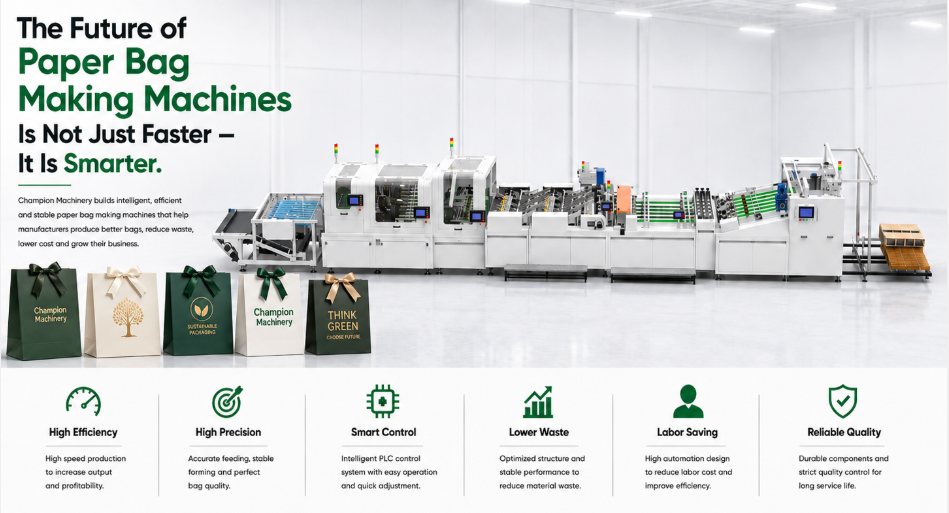
Why Speed Alone Is No Longer Enough
A high-speed paper bag machine can improve production capacity, but speed without stability can create new problems.
If a machine runs fast but produces unstable bags, frequent waste, poor folding accuracy, or inconsistent gluing quality, the factory will lose efficiency instead of gaining it. In real production, the most valuable machine is not always the fastest one. It is the machine that can run continuously, maintain consistent quality, and reduce human intervention.
For paper bag manufacturers, stable performance is often more important than maximum speed.
A smarter paper bag making machine helps factories achieve a better balance between speed, quality, flexibility, and cost control.
What Makes a Paper Bag Making Machine Smarter?
A smart paper bag making machine is designed to improve the entire production process, not just the output number.
It combines mechanical precision, automatic control, material adaptability, intelligent monitoring, and user-friendly operation. The goal is to make paper bag production more stable, more efficient, and easier to manage.
A smarter machine usually focuses on several key areas:
1. Better Material Adaptability
Modern paper bag manufacturers often need to process different materials, such as kraft paper, coated paper, white cardboard, art paper, recycled paper, and laminated paper.
Different materials behave differently during feeding, folding, gluing, pressing, and forming. A smart paper bag machine should be able to handle material changes with better stability and fewer adjustments.
Good material adaptability helps factories produce more types of paper bags and serve more customers, including retail brands, food packaging companies, luxury packaging suppliers, and shopping bag manufacturers.
2. More Stable Forming Quality
Bag forming quality directly affects the final product.
A well-designed paper bag making machine should maintain accurate paper feeding, precise folding, stable side gluing, strong bottom forming, and clean finished bag output.
For packaging buyers, the appearance of the paper bag represents the brand image. Uneven folding, weak glue lines, poor bottom forming, or size deviation can reduce customer trust.
Smart machine design helps maintain consistent bag quality, especially during long production runs.
3. Lower Waste Rate
Paper waste is a hidden cost in paper bag production.
When a machine requires frequent adjustment, causes unstable feeding, or produces defective bags, the factory loses raw material, labor time, and production efficiency.
A smarter paper bag making machine helps reduce waste through stable paper feeding, accurate positioning, reliable gluing, and better tension control.
Lower waste means lower production cost and higher profit margin.
4. Faster Changeover for Different Orders
Packaging factories rarely produce only one type of bag.
They may need to switch between different bag sizes, paper materials, handle types, printing designs, and customer orders. If every changeover takes too much time, production efficiency will drop.
Smart paper bag machines are becoming more flexible. They are designed to support faster adjustment, easier operation, and more efficient order switching.
This is especially important for manufacturers serving customized packaging markets.
5. Easier Operation and Reduced Labor Dependence
Labor cost and skilled operator availability are major concerns for many packaging factories.
A machine that requires too many manual adjustments or highly experienced operators can become difficult to manage. A smarter paper bag machine should make operation easier through automatic control systems, clear interfaces, simplified adjustment points, and stable mechanical design.
The more user-friendly the machine is, the easier it is for factories to train operators and maintain production consistency.
6. Intelligent Monitoring and Maintenance
In the future, more paper bag making machines will include intelligent monitoring functions.
These may include production data tracking, machine status monitoring, fault alerts, maintenance reminders, and remote diagnosis support.
For factory owners, this means fewer unexpected stops, faster troubleshooting, and better production management.
A smart machine is not only a piece of equipment. It becomes part of the factory’s production data system.
How Smart Paper Bag Machines Support Sustainable Packaging
The global packaging industry is moving toward more sustainable materials and more recyclable packaging solutions.
Paper bags are widely used in retail, food service, fashion, cosmetics, gifts, shopping, and luxury packaging. As brands look for alternatives to difficult-to-recycle plastic packaging, paper-based packaging continues to gain attention.
However, sustainable packaging is not only about using paper.
It also requires efficient production, lower waste, stable quality, and the ability to process different types of paper materials.
This is where smart paper bag making machines become important.
A modern paper bag machine can help manufacturers produce paper bags more efficiently while reducing material waste and improving production consistency. For brands and packaging suppliers, this creates a stronger connection between sustainability and real manufacturing capability.
The Role of Automation in Paper Bag Production
Automation is one of the most important trends in paper bag machinery.
A fully automatic paper bag making machine can reduce manual work in feeding, forming, gluing, bottom forming, handle application, collection, and other production steps.
Depending on the machine type, automation may include:
Automatic paper feeding
Automatic side gluing
Automatic tube forming
Automatic bottom forming
Automatic bottom card insertion
Automatic handle pasting
Automatic rope or ribbon insertion
Automatic counting and collection
Intelligent control and fault detection
The value of automation is not only higher speed. It also helps factories improve consistency, reduce labor intensity, and increase production reliability.
Choosing a Paper Bag Making Machine: What Buyers Should Look For
When choosing a paper bag making machine, buyers should look beyond the speed specification.
A good purchasing decision should consider the full production needs of the factory.
Important questions include:
What types of paper bags do you need to produce?
What paper materials and paper weights will you use?
Do you need handles, ropes, ribbons, or bottom cards?
How often do you change bag sizes?
What is your expected production volume?
How many operators are available?
What level of automation do you need?
How important is waste reduction?
Do you need support for customized packaging orders?
The right machine should match your product structure, customer requirements, factory space, labor conditions, and long-term business plan.
Smart Paper Bag Making Machines Create More Business Opportunities
For packaging manufacturers, upgrading to smarter paper bag machinery is not only about improving production. It can also open new business opportunities.
With better machine flexibility and stability, factories can produce more types of paper bags, serve more industries, and accept more customized orders.
For example, one production line may support paper shopping bags, luxury paper bags, gift bags, food service bags, clothing bags, cosmetic packaging bags, and retail packaging bags.
This flexibility allows manufacturers to respond faster to market changes and customer demands.
In a competitive packaging market, the factory that can deliver stable quality, shorter lead time, and flexible customization will have a stronger advantage.
The Future: From High-Speed Machinery to Intelligent Production Lines
The next generation of paper bag making machines will not be defined by speed alone.
They will be defined by intelligent production capability.
Future paper bag machinery will likely focus more on:
Smart sensors
Production data analysis
Remote technical support
Predictive maintenance
Faster changeover systems
Better material compatibility
Lower waste production
Higher automation integration
More flexible packaging solutions
In other words, the paper bag machine will become part of a smarter packaging factory.
For manufacturers, this means better control over cost, quality, delivery time, and production capacity.
Conclusion
The future of paper bag making machines is not just faster — it is smarter.
Speed is still important, but it is no longer the only standard. Packaging manufacturers now need machines that can deliver stable quality, flexible production, material adaptability, lower waste, easier operation, and intelligent production management.
A smart paper bag making machine helps factories produce more than paper bags.
It helps them build a more competitive, efficient, and future-ready packaging business.
As the demand for paper packaging continues to grow, manufacturers who invest in smarter paper bag machinery will be better prepared for the next stage of the packaging industry.
FAQ
What is a paper bag making machine?
A paper bag making machine is industrial equipment used to produce paper bags from roll paper or sheet paper. It can complete processes such as paper feeding, folding, gluing, tube forming, bottom forming, handle application, and finished bag collection.
Why is automation important in paper bag making machines?
Automation helps reduce manual labor, improve production efficiency, increase bag quality consistency, reduce waste, and make large-scale paper bag production easier to manage.
Is the fastest paper bag machine always the best choice?
Not always. Speed is important, but buyers should also consider machine stability, material compatibility, waste rate, operation difficulty, after-sales support, and the types of bags they need to produce.
What industries use paper bag making machines?
Paper bag making machines are widely used in shopping bags, food packaging, fashion retail, gift packaging, cosmetics packaging, luxury packaging, supermarket bags, and general paper packaging production.
What should buyers consider before purchasing a paper bag making machine?
Buyers should consider bag type, paper material, production speed, automation level, factory space, operator skill level, order flexibility, maintenance requirements, and long-term production needs.